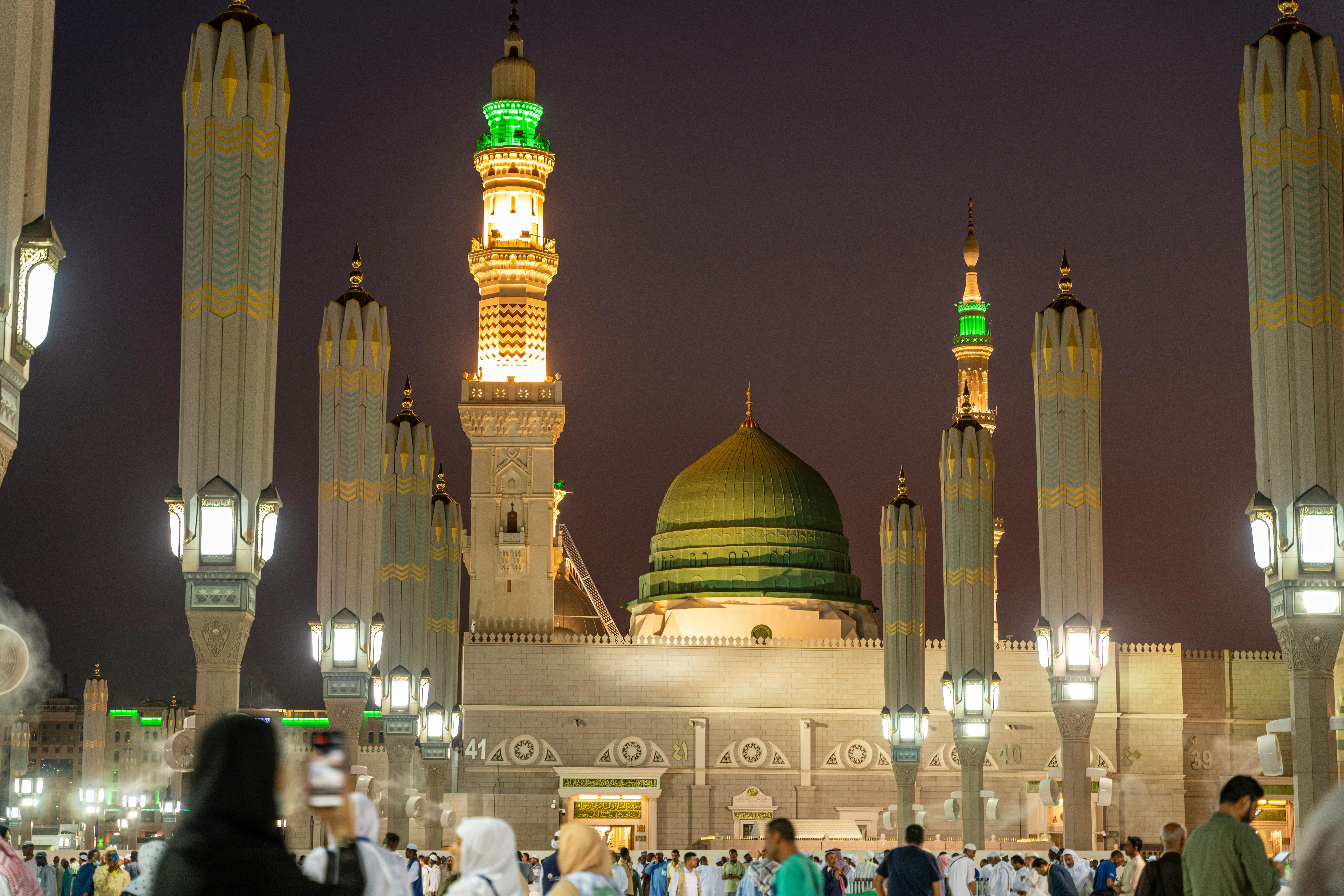
Prophethood of Prophet Muhammad (s)
Prophethood began with Adam and culminated in Muhammad as the final prophet, delivering the message of monotheism and submission to God. Muhammad's life involved early hardships, revelation in the Cave of Hira, secret and open propagation of Islam in Mecca amid persecution, migration to Medina (Hijra), key battles like Badr, Uhud, Ahzab, and Khaybar, the peaceful conquest of Mecca, and the Farewell Pilgrimage where he appointed Ali as successor at Ghadir Khumm. Preparations for Imam Al-Mahdi's future arrival emphasize justice and guidance from the Ahl al-Bayt.
About This Event
H. From Adam (‘A) To Muhammad (S) – One Line Prophethood has been a continuous process; it started with Prophet Adam (S), the first man, and ended with the last of them, the seal of prophethood, Prophet Muhammad (S). All prophets (‘a) have come with the same message, the message of One God and total submission to Him. They have come for the guidance of man and his eternal success.
“Muhammad is not the father of [any] one of your men, but [he is] the Messenger of God and last of the prophets. And ever is God, of all things, Knowing.” (The Holy Qur’an, 33:40).
“Those who follow the Messenger, the unlettered prophet, whom they find written in what they have of the Torah and the Gospel, who enjoins upon them what is right and forbids them what is wrong and makes lawful for them the good things and prohibits for them the evil and relieves them of their burden and the shackles which were upon them. So they who have believed in him honoured him, supported him and followed the light which was sent down with him – it is those who will be successful.” (The Holy Qur’an, 7:157).
“Say, [O Muhammad], “O mankind, indeed I am the Messenger of God to you all, [from Him] to whom belongs the dominion of the heavens and the earth. There is no deity except Him; He gives life and causes death.” So believe in God and His Messenger, the unlettered prophet, who believes in God and His words, and follow him that you may be guided.” (The Holy Qur’an, 7:158).
The prophets (‘a) were given the divine message in order to lead man towards perfection and therefore, nearness to God. Every prophet (‘a), during his time on earth, was the perfect man, free of flaws and sin, and therefore a role model for his people. God blessed His prophets (‘a) with clear signs and miracles. They were fearless men who occasionally had to stand alone facing thousands of enemies and deniers. They had to endure great trials and tribulations. The prophets (‘a) made great sacrifices in order to guide mankind.
“And certainly, were messengers denied before you, but they were patient over [the effects of] denial, and they were harmed until Our victory came to them. And none can alter the words of God. And there has certainly come to you some information about the [previous] messengers.” (The Holy Qur’an, 6:34).
Prophet Muhammad (S) is the prophet of Islam, the prophet to present the final message. He announced himself as a servant of God and God´s Messenger. Similarly, he proclaimed that all prophets (S) before him were the servants of God and His messengers. One of the Prophet’s (S) missions were, through the word of God in the Holy Qur’an, to clarify that neither he nor any prophet (‘a) before him claimed to be God, a part-deity or an embodiment of God.
“It is not for a human [prophet] that God should give him the Scripture and authority and prophethood, and then he would say to the people, ‘Be servants to me rather than God,’ but [instead, he would say], ‘Be pious scholars of the Lord because of what you have taught of the Scripture and because of what you have studied.’” (The Holy Qur’an, 3:79).
“And [beware the Day] when God will say, ‘O Jesus, Son of Mary, did you say to the people, ‘Take my mother and me as deities besides God?’’ He will say, ‘Exalted are You! It was not for me to say that to which I have no right. If I had said it, You would have known it. You know what is within myself, and I do not know what is within Yourself. Indeed, it is You who is Knower of the unseen.” (The Holy Qur’an, 5:116).
I said not to them except what You commanded me – to worship God, my Lord and your Lord. And I was a witness over them as long as I was among them; but when You took me up, You were the Observer over them, and You are, over all things, Witness’.” (The Holy Qur’an, 5:117).1
Prophet Muhammad (S) encouraged Muslims to believe in the prophets (S) before him. In total, 124 000 prophets were sent from God. Many of them were sent to one or several villages, cities or areas simultaneously, others were sent to great tribes, and in some cases, a prophet (‘a) was sent to one and one person only. Other prophets (‘a) were sent to greater areas or to whole nations. Prophet Muhammad (S) was sent to all of mankind with a message valid until the end of time. Among the prophets (‘a) who were sent before the time of the Holy Prophet (S) and who are mentioned in The Holy Qur’an, are the following prophets (‘a) [Latin name in brackets]: Adam, Nooh [Noah], Hood [Hud], Salih [Saleh], Ibrahim [Abraham], Lut, Ismail [Ismael], Ishaq [Isak], Ya’qoob [Jakob], Yusof [Josef], Musa [Moses], Haroon [Aron], Dawood [David], Yunos [Jona], Yahya [Johannes] and Isa [Jesus]. Prophet Muhammad (S) would speak of earlier prophets (‘a) in admiration, called them his brothers and encouraged his followers to respect them. He mentioned their eminent god-fearing personalities in order for all to gain knowledge; he did this by using the depiction of them in the Holy Qur’an. Meanwhile, he underlined the common basic message that all prophets had been sent to mediate.
“Say, ‘O People of the Scripture, come to a word that is equitable between us and you – that we will not worship except God and not associate anything with Him and not take one another as lords instead of God.’ But if they turn away, then say, ‘Bear witness that we are Muslims [submitting to Him].’” (The Holy Qur’an, 3:64).
“Say, ‘We have believed in God and in what was revealed to us and what was revealed to Abraham, Ishmael, Isaac, Jacob, and the Descendants, and in what was given to Moses and Jesus and to the prophets from their Lord. We make no distinction between any of them, and we are Muslims [submitting] to Him.’” (The Holy Qur’an, 3:84).
“And We have already sent messengers before you. Among them are those [whose stories] We have related to you, and among them are those [whose stories] We have not related to you. And it was not for any messenger to bring a sign [or verse] except by permission of God. So when the command of God comes, it will be concluded in truth, and the falsifiers will thereupon lose [all].” (The Holy Qur’an, 40:78).
“Indeed, We have revealed to you, [O Muhammad], as We revealed to Noah and the prophets after him. And we revealed to Abraham, Ishmael, Isaac, Jacob, the Descendants, Jesus, Job, Jonah, Aaron, and Solomon, and to David, We gave the book [of Psalms]” (The Holy Qur’an, 4:163).
“And [We sent] messengers about whom We have related [their stories] to you before and messengers about whom We have not related to you. And God spoke to Moses with [direct] speech]” (The Holy Qur’an, 4:164).
“[We sent] messengers as bringers of good tidings and warners so that mankind will have no argument against God after the messengers. And ever is God Exalted in Might and Wise” (The Holy Qur’an, 4:165).
“And that was Our [conclusive] argument which We gave Abraham against his people. We raise by degrees whom We will. Indeed, your Lord is Wise and Knowing. And We gave to Abraham, Isaac and Jacob.” (The Holy Qur’an, 6:83).
“all [of them] We guided. And Noah, We guided before; and among his descendants, David and Solomon and Job and Joseph and Moses and Aaron. Therefore, do We reward the doers of good? And Zechariah and John and Jesus and Elias.” (The Holy Qur’an, 6:84).
“and all were of the righteous. And Ismael and Elisha and Jonah and Lot.” (The Holy Qur’an, 6:85).
“and all [of them] We preferred over the worlds. And [some] among their fathers and their descendants and their brothers.” (The Holy Qur’an, 6:86).
“and We chose them, and We guided them to a straight path.” (The Holy Qur’an, 6:87).
Prophets (‘a) received, by the wisdom of God, decrees and regulations which were adapted to their specific time and people. As man’s collective maturity and experience increased, succeeding prophets (‘a) confirmed the message of the prophets (‘a) before them and added new regulations from God. In some cases, again by the order of God, some regulations were annulled. Prophet Muhammad (S), as the seal of prophethood, received the final and complete message, the one that covered and tied up the message of all earlier prophets (‘a) combined.
I. The Holy Prophet (S) [The First Ma’soom] – The Story Of The Prophet (S) I1. Before The Revelation Of The Holy Qur’an Birth And Early Childhood Prophet Muhammad (S) was born, according to the Islamic calendar, on the 17th of Rabi’ Al-awwal in the year 570 AD. Many signs could be seen at the time of his birth;2 signs that followers of earlier prophets (‘a) had awaited and recognized!3 Hence, in particular, the scholars among them knew that the last Prophet (S) was born.
“Those to whom We gave the Scripture know him as they know their own sons. But indeed, a party of them conceal the truth while they know [it].” (The Holy Qur’an, 2:146).
The Holy Prophet (S) had to endure many difficulties, even in his childhood. His father Abdullah (r.a.), passed away just a few months before his blessed birth. At the age of six, his mother, Amina (r.a.), also passed away. After the heavy loss of his mother, he was looked after by his grandfather, Abd Al-Muttalib (r.a.). When the Prophet (S) was eight years of age, Abd Al-Muttalib (r.a.) passed away as well. After that his new care-takers became his uncle Abu Talib (r.a.) and his uncle’s wife Fatimah bint Asad (r.a.). They both loved and were highly fond of the Holy Prophet (S) and taught their children to love and respect him as well.
In Society To obtain a deeper knowledge of the Holy Prophet (S) and his unique character, it is of importance to understand the society of his time. The days preceding Islam were called Jahiliyyah (an era of ignorance – pre-Islamic time). Imam Ali (‘a) described the era of ignorance as well as the Arabs combative way of life, their debauchery and their moral decay had reached a critical state:
“Indeed God – praised and free of sin He is – sent [Prophet] Muhammad – may the blessings of God be upon him and his family the Ahl Al-Bayt (‘a) – [as] a warner for the worlds and as a [safe] keeping of the down sent [revelation], and [this while] you, gathering [of] Arabs [were] in the worst of beliefs, and in the worst of abodes, living between hard stone. And deaf snakes, drinking musty [water], and eating distasteful [food], and spilling your blood, and cutting bloodlines, [while] the idol worshipers among you were exalted, and sins through you were consolidated.”4
In addition to this, infant girls were being buried alive. In the Holy Qur’an, God condemns this inhumane behaviour in powerful words:
“And when one of them is informed of [the birth of] a female, his face becomes dark, and he suppresses grief.” (The Holy Qur’an, 16:58).
He hides from the people because of the ill of which he has been informed. Should he keep it in humiliation or bury it in the ground? Unquestionably, evil is what they decide.” (The Holy Qur’an, 16:59).
In that society, a woman was similar to that of merchandise; she could be bought, sold or even be pillaged during bloody raids together with other bounties. Women and slaves had neither social rights nor rights to inheritance. When people feared famine, they could sacrifice their children for idols, decapitate their daughters, throw them off of high mountains and sometimes even drown them.
In the midst of this dark and decaying society came, miraculously, God’s pearl of creation, and blossomed like a flower in the midst of the desert. Prophet Muhammad (S) was, from a young age onwards, known among the people for his character. Despite his tribe affiliation and the special status he held, being Abd Al-Muttalib’s (r.a.) most loved grandchild, he lived a very simple life among the people.5 From a young age, the Holy Prophet’s (S) uncle, Abu Talib (r.a.), used to take with him the Holy Prophet (S) on his business trips. His kind manners and behaviour towards everyone, his fine work ethic and his consideration and his benevolence, which he did not hold back from anyone, as well as his help of the needy and oppressed, made young Muhammad (S) more and more famous as the days went by.
The amplitude of his exemplary character was not limited to the caravans, but his beautiful morals were widely known in all of Mecca; so much that the inhabitants had started calling him Muhammad Al-Amin (the trustworthy one). In that way had the Holy Prophet (S) grown up to become a respected young man, whose magnanimity and generosity reached everyone. At the same time, his dislike of all forms of oppression and injustice was easy notable through his actions. In a society where the elites in power elevated their positions on the backs of slaves, he distanced himself from inaction and indolence and insisted on performing all his duties by himself and helping others in theirs. In all the gatherings, he was the hardest working one, relieving others, simultaneously donating most of his earnings to the needy. Even though he was of great character and did great deeds, he was never arrogant and always stayed humble.
He always had a smile and used to approach everyone with a good attitude. His harmonious personality and his peaceful soul attracted the people, leaving traces in his surroundings wherever he went. He used to speak clearly and with a tone of respect, and when others spoke, he was attentive. He would never use improper language. Among the people, he was known for his righteousness and his piety. He would always keep his word and would never lie. In an era where oppression was roaring and the rich and powerful were forcing obedience, his humility and frankness won the hearts of the people. Like a wise and loving father, he would walk through the city in order to find those who were in need and help them. He asked the sick how they were and looked out for them, helped and comforted the outcasts and the orphans and was generous towards the poor and destitute. The people who were abandoned, alone and oppressed, especially the orphans, got the most of his attention. If a human in need asked for his assistance, he would not turn him down. On many occasions, he would give his own food to the poor and stay hungry himself. His thoughtfulness for all creatures would appear in his attention and behaviour towards everything from plants to animals. His perspective and behaviour were impregnated with love, wisdom and mercy. These high morals and polite character made him respected and trusted by all in society long before prophethood. His good judgment and fair opinions made numerous people turn to him for advice, asked him to mediate during conflicts and sought his solutions for all kinds of affairs.6
It was in this manner that the Holy Prophet (S) was hired to lead the caravans of the most esteemed and wealthy in society. Khadija (r.a.), who came to be the Holy Prophet’s (S) loving wife and faithful companion when he was twenty-five years of age. It was also Khadija (r.a.) who came to be the mother of the Holy Prophets (S) dear daughter Fatimah az-Zahra’ (‘a), the mother of the Imams (‘a) of the Ahl Al-Bayt (‘a).
Before the start of the Holy Prophet’s (S) calling, he used to spend many days and nights in solitude in the cave of Hira’. He spent many days in worship and seeking God’s closeness. Imam Ali (‘a), around nine of age at the time, used to bring food Khadija (r.a.) had prepared the Holy Prophet (S). During a period of drought and difficulties in Mecca, the Holy Prophet (S) had taken his cousin Ali (‘a), the son of Abu Talib (r.a.), to his own home so he would be able to look after him. Hence, the Holy Prophet (S) raised Imam Ali (‘a) from an early age. They had a strong and keen connection. The Holy Prophet (S) cared for Ali (‘a) as his own son, just like Ali’s (‘a) father once had taken care of him. When the Holy Prophet (S), at the age of forty, on the night of 27th Rajab, in the year 610 AD, went to Hira’ in order to worship his God, the angel Jibrail (‘a) [Gabriel] approached him and asked the Holy Prophet (S) to recite:
“Recite in the name of your Lord who created.” (The Holy Qur’an, 96:1).
“Created man from a clinging substance.” (The Holy Qur’an, 96:2)
“Recite, and your Lord is the Most Generous.” (The Holy Qur’an, 96:3).
“Who taught by the pen.” (The Holy Qur’an, 96:4).
“Taught man that which he knew not.” (The Holy Qur’an, 96:5)7
The Holy Qur’an, The Revealed Word Of God And The Foremost Miracle Of The Holy Prophet (S) The revelations of The Holy Qur’an, had now begun. In the Arabic community, rhetoric and poetry constituted both merits and a powerful and influential tool. The people of the time were therefore highly conversant in those fields and possessed linguistic abilities only a few people have today. They lived in an era where eloquence and language were of most important in society, so much so that the abilities of today cannot be compared to theirs. Therefore, they could not deny the superiority of The Holy Qur’an, regarding its linguistics and content.
“Then do they not reflect upon the Qur’an? If it had been from [any] other than God, they would have found within it much contradiction.” (The Holy Qur’an, 4:82).
“Then let them produce a statement like it if they should be truthful.” (The Holy Qur’an, 52:34).
“And if you are in doubt about what We have sent down upon Our Servant [Muhammad], then produce a surah the like thereof and call upon your witnesses other than God, if you should be truthful.” (The Holy Qur’an, 2:23).
“But if you do not – and you will never be able to – then fear the Fire, whose fuel is men and stones, prepared for the disbelievers.” (The Holy Qur’an, 2:24).
“Or do they say, ‘He invented it’? Say, ‘Then bring ten surahs like it that have been invented and call upon [for assistance] whomever you can besides God, if you should be truthful.’” (The Holy Qur’an, 11:13).
“Say, ‘If mankind and the djinn gathered in order to produce the like of this Qur’an, they could not produce the like of it, even if they were to each other assistants.’” (The Holy Qur’an, 17:88).
I2. Islam In Mecca The First To Accept Islam (Year 13 Bh/610 Ad) After the revelation of the first verses of The Holy Qur’an, and that of the Prophet´s (‘a) homecoming – his wife, Khadija (r.a.), became the first person and the first woman to accept the prophethood of Muhammad (S) and the religion of Islam. Imam Ali (‘a) who was aware of this revelation, did not hesitate for a moment, and he too accepted the message of the Holy Prophet (S). Therefore, Imam Ali (‘a) became the first of men to accept Islam at the young age of ten.
With the first revelation – the mission to reform society had begun. The Holy Prophet (S) came with the final message and to guide man so that he would be able to reach his full potential.
The state of matters in the communities at that time initially inhibited the Holy Prophet (S) from speaking publicly of his calling. During the first three years, he was instead ordered by God to invite people to Islam without causing too much of a commotion.
An Open Invitation To Islam Begins – An Invitation To The Nearest After the first three years, conducted in secret, it was now time to announce the calling of Islam openly. God commanded the Holy Prophet (S) to begin with the ones closest to him in blood. The first invitation was announced in verse:
“And warn, [O Muhammad], your closest kindred.” (The Holy Qur’an, 26:214).
When the verse was sent down, and the command of God was issued, the Holy Prophet (S) asked Imam Ali (‘a) to prepare a meal and invite his kinfolk. Even though the food was initially made to fill one belly, they all ended up eating quite the amount. Afterwards, the initial food portion was left, as if untouched. It was a surprise to everyone and while seeing this, Abu Lahab, the Holy Prophet’s (S) uncle – later to be the arch-enemy of Islam – called out: “This is nothing but magic and sorcery.” The Holy Prophet (S) did not get the chance to speak as he was interrupted, and everyone left dinner.
Nonetheless, on the next day, the Holy Prophet (S) asked Imam Ali (‘a) yet again to prepare a meal for everyone and sent out the invitations. Again, everyone ate themselves fully, but the food still would not decrease. Eventually, the Holy Prophet (S) got a chance to speak and said:
“O sons of Abd Al-Mutallib (‘a), by God, there is no one among the Arabs who has brought his people better than what I am bringing you; I have brought you what is good in this world and what is good in the next, and God has commanded me to invite you towards him, so who among you will stand on my side in this mission? And will then be my brother, the implementor of my will and my successor among you.”
When the Holy Prophet (S) stopped speaking the crowd became silent, and no one moved. In the midst of the crowd, Imam Ali (‘a) stood up and answered:
“I, O Messenger of God, will stand with you in this”
The Holy Prophet (S) asked Imam Ali (‘a) to sit down and then repeated his question three times. Each time no one but Imam Ali (‘a) answered affirmatively. The Holy Prophet (S) then placed his hand on the neck of Imam Ali (‘a) and said:
“Surely, this is my brother, the implementor of my will and my successor among you; listen to him and obey him.”8
This event, on the one hand, shows the strong conviction and bravery of the young Imam Ali (‘a), when there were barely any other Muslims, and on the other, how the Holy Prophet (S) and his successors (‘a) positions are strongly combined and linked together. On that same day – the Holy Prophet (S) declared his prophethood, and shortly after he also presents his successor.
The Open Invitation To Islam Continues The Holy Prophet (S) continued with his mission. Before prophethood, the Holy Prophet (S) had lived among his people for forty years and was known as an honest and reliable man who had never spoken a lie, deceived anyone or broken a promise. He was therefore known as being a truthful and just man. When the Holy Prophet (S) one day climbed upon a mountain to demonstrate his trustworthiness, which was consolidated even more by people’s testimony and faced those who had gathered upon his call and said:
“O, people! Will you believe me if I told you that your enemies are deployed on the other side of this mountain [Safa] and that they are planning to attack you and your possessions?”
Even with the likelihood of this actually being true, the people still confirmed that they believed it, seeing as the honesty of the Holy Prophet (S) had no parallel. They answered:
“We have never heard you tell any lie!”
The Holy Prophet (S) made the most of their testimony and continued:
“I am, indeed, today a warner of a firm punishment. I call you to testify that there is no god but God and that I am His messenger. And I call you to denounce idols.”
And as such, the Holy Prophet (S) declared the message God had sent him and announced that he was the final messenger of God. The Holy Prophet (S) called the people to believe in God and to perform good deeds, to help the poor and needy, to look after the sick and the orphans, and to defend justice and to resist tyranny. He called upon the people to abandon their idolatry and their customs opposing humanity and mercy and to instead return to pure faith so that they may acquire what is good of this world and the hereafter.9
Islam Starts To Expand, And The Elite Of Mecca Feels Threatened As a result of the Holy Prophet’s (S) invitation, his great patience and his hard efforts, Islam started to expand. This made the elite, among them the Quraysh, feel threatened. The Quraysh was the tribe in control of Mecca at the time. They were dependent on injustices taking place in the community and idolatry, only so to stay in power and keep their economic benefits. Therefore, they felt threatened by the advocator of monotheism, justice and equality.
The leaders of the Quraysh got together and decided to turn towards Abu Talib (r.a.), the tribe elder who had a distinguished position. They let him know they were not tolerating the message of the Holy Prophet (S). Initially, the Quraysh requested Abu Talib (r.a.) to present their demands to his nephew and have him renounce his calling to God. In turn, they would reward the Holy Prophet (S) riches, power and possessions. The Holy Prophet (S) could have security and all that he could wish for if only he would stop preaching monotheism. At that time, the Muslim movement was in its initial phase, relatively small and subjected to many external threats. It was in this critical and hard condition that the Holy Prophet (S) answered:
“If you were to put the sun in my right hand and the moon in my left, and give me all the riches of the world, I would still refuse to denounce this call.”10
The Holy Prophet’s s (S) answer clarified his stand and his unwavering strength in the path of God, and at the same time dismantling every attempt made to spread rumours that his purpose was materialistic. His message was for a greater cause than that of worldly rewards and possessions.
Abu Talib (r.a.), who was aware of the Holy Prophet’s (S) truthfulness, firmly supported him. He presented the Holy Prophet’s (S) reply to the Quraysh and explained that he supported his nephew. The Quraysh knew that no harm would be done to the Prophet (S) as long as Abu Talib (r.a.) lived because none would cause a dispute with the Bani Hashim11, a branch of the Quraysh tribe known for their courage. Like his father, Abd Al-Muttalib (r.a.), Abu Talib (r.a.) was also a true monotheist; he was a follower of Islam and a nobleman. He had a big heart, but he could not proclaim his faith in public in order to keep his role as the tribe leader and thereby continue his ‘neutral’ role to protect the Holy Prophet (S). However, as the Holy Prophet (S) could not be bribed, the Quraysh proceed to another method. They had now started to pressure by discriminations, threats, sanctions, violence, torture and even murder.12
Migration To Abyssinia, Economic Sanctions And A Blockade When the perseverance of the Muslims reached its height, the Holy Prophet (S) asked some of his followers to emigrate to Abyssinia, where a just Christian, by the name of Najjashi, was king. This was the first migration ever embarked on in the history of Islam. It took place during the fifth year of the Islamic calling, year 615 AD. When the persecution of the Muslims in Mecca got more intense, the Holy Prophet (S) decided to send more Muslims to Abyssinia. Meanwhile, Quraysh also sent their representatives to Abyssinia. They brought with them gifts to the Christian king, hoping that he would hand over the Muslims and send them back to Mecca, where they would be persecuted. However, the king refused to accept their enquiry until hearing whatever the Muslims had to say. Ja’far Ibn Abu Talib (r.a.) who had led the Muslims to Abyssinia, by orders of the Holy Prophet (S), spoke before the king and told him the message that God had sent the Holy Prophet (S). The fellowship of the message of Islam and Christianity touched the king’s heart, and he refused to expel the Muslims from his land. He allowed them to stay under his protection while the representatives of Quraysh were expelled.
While Islam was progressing the leaders of the Quraysh grew more anxious. They were concerned as they witnessed prominent characters, such as the Holy Prophet’s (S) uncle, Hamza (r.a.), embrace Islam all while Muslims were living peacefully in Abyssinia. The Quraysh’s plans failed; however, they continued scheming to hope to abuse Muslims and stop the expansion of Islam.
The Quraysh decided to implement more sanctions and eventually, a full economic blockade launched. They signed a treaty banning all trade, associations and marriages with the Bani Hashim. Assisting or aiding the Bani Hashim would be considered a crime. They sought to divide the Bani Hashim so that they may bicker among themselves and eventually compel the Holy Prophet (S) to capitulate. In this way, the Muslims have driven away from their homes in Mecca and banished to a valley between the mountains, on the outskirts of the city. This valley was known as the Valley of Abu Talib. The Holy Prophet (S) and his followers have strictly prohibited this area. The treaty was kept by the Quraysh in the Ka’ba. The blockade lasted for three years, and during this time, the Holy Prophet (S) and the Muslims were subjected to massive pressure, not least because of a shortage of food and water. During that time, they had been struck by famine, and the conditions were so difficult that they had to share dates (as nutrition) in order to survive.
After three strenuous years of boycott and tribulations, the Muslims’ perseverance and patience resulted in God’s promised help. It was revealed to the Holy Prophet (S) that God ordained a termite to eat up the signed treaty. Miraculously, leaving the name of God on top of the treaty. Abu Talib (r.a.) sent a message to Quraysh that they ought to confirm this. And thereby, the blockade ended.
The Year Of Sorrow And Migration To Medina The blockade ended the tenth year of the Holy Prophet’s (S) calling, year 619 AD. It was also during this year that two deeply tragic events took place. Two of the Holy Prophet’s (S) dearest and greatest aiders tragically passed away. That is, the Holy Prophet’s (S) supportive uncle and loving wife, Abu Talib (‘a) and Khadija (‘a). The Holy Prophet (S) named this year ‘The Year of Sorrow’, attributed to the great grief and hardships to follow after their demise. They had now lost two highly important individuals, as they were the ones not only to morally support the Prophet (S) but also offer their status and possessions to provide social and economic protection and support. Abu Talib (‘a) and Khadija (‘a) were both prominent personalities in Islam and had key roles during the first critical years. They had, in both words and actions, demonstrated their unfaltering acceptance of Islam.
Nonetheless, Islam continued to spread. When people of neighbouring cities pilgrimed to Mecca during the pilgrimage season, several highly-ranked men of an important tribe came in contact with the Holy Prophet (S) and accepted Islam. On their way back to their hometown of Yathrib, the Holy Prophet (S) sent a missionary with them. This led to huge amounts of people accepting Islam in Yathrib, and they returned the following year with representatives to Mecca, in order to pledge allegiance and obedience to the Holy Prophet (S).
The Quraysh found out and were very upset. The Holy Prophet’s (S) calling had reached its thirteenth year, and all of the attempts by the Quraysh to bribe, threaten, torture and pressure through economic and social means had completely failed. When Islam started to reach new tribes, Quraysh noticed an even greater danger posed against them and the social order, allowing them to stay in power. They were so desperate that an attempt to kill the Prophet (S) was planned. Due to old vengeance traditions in the Arabic communities, no one dared to carry out the plan and be blamed. Therefore, the leaders gathered and schemed a dark assassination-plan in which a member of every tribal branch would contribute. This assembly would come into the home the Prophet (S) during the night-time and kill him. In that way, no single tribe would be blamed and no one would be able to demand revenge on behalf of the Holy Prophet (S). The night of the plan had arrived, but through revelation, God warned His Prophet (S) of the planned attack and ordained him to leave Mecca that same night:
“And [remember, O Muhammad], when those who disbelieved plotted against you to restrain you or kill you or evict you [from Mecca]. But they plan, and God plans. And God is the best of planners.” (The Holy Qur’an, 8:30).
The Prophet (S) asked Imam Ali (‘a) to sleep on his stead. Imam Ali (‘a) wore the green cloak of the Holy Prophet (S) and crawled into bed, honoured to serve his holy mission, with no fear. God then revealed the following verse in Imam Ali’s (‘a) honour:
“And of the people is he who sells himself, seeking means to the approval of God. And God is kind to [His] servants.” (The Holy Qur’an, 2:207).
It was the first of Rabi’ Al-awwal year 622 AD, and Imam Ali (‘a) was sleeping calmly in the Holy Prophet’s (S) bed until dawn. The Holy Prophet (S) had during this time, started his migration to Yathrib. At dawn, the enemy charged on the Prophet´s (S) home with swords and arrows, only to find Imam Ali (‘a) beneath the cloak. As Imam Ali (‘a) would not inform them of the Prophet´s (S) whereabouts, they left in a hurry in the hope of catching up with wherever he had gone.
They were assisted by a pathfinder who had tracked down the Prophet (S) to a cave. However, the entrance to the cave was coated with spiderwebs and blocked by a smaller nest of pigeons with no sign of the Prophet’s (S) presence. They were unaware that God Almighty had saved His Messenger (S) with those uninhabitable signs.
The enemies lost hope in finding the Prophet (S) and left. The Prophet (S) continued onward towards Yathrib, where its natives were waiting for his arrival. On the 12th of Rabi’ Al-awwal year 622 AD, the Holy Prophet (S) reached a place called Qoba13. Here the Holy Prophet (S) stopped to wait for Imam Ali (‘a), so they would continue to Yathrib together.
Shortly thereafter, Imam Ali (‘a) completed a couple of tasks the Holy Prophet (S) had left for him, and began his trip towards Yathrib. He had brought along the Holy Prophet’s (S) daughter Fatimah az-Zahra’ (‘a), his own mother Fatimah bint Asad (r.a.) and his uncle’s daughter. During the daytime, he would protect the women against enemy attacks and during night-time, they would continue their journey. After several days on foot, they finally reached Qoba. Imam Ali’s (‘a) feet were swollen and bleed, so much so that he could barely walk anymore. Nonetheless, the Holy Prophet (S) rejoiced at Imam Ali’s (‘a) arrival, finally reunited.
Thereafter they all headed towards Yathrib together. They were greeted by the natives and their children's’ songs, sung in their honour. From this day onward, the city of Yathrib would be known as Madinat an-Nabi (The city of the Prophet) – Medina (The city) – and its name was now eternally tied to the arrival of the Holy Prophet (S). The emigration from Mecca to Medina was called Hijra and was of such importance that it became the start of the Islamic calendar. Hence, the year 622 AD would correspond to the first year after Hijra [AH].
I3. Islam In Medina The Holy Prophet (S) could now speak openly about Islam in Medina, as opposed to Mecca, where the Muslims were being oppressed. The atmosphere of tolerance and goodwill among the Muslims made Medina a special city now shining because of the presence of the Holy Prophet (S) and was therefore called ‘Medinat Al-Munawarra’ (The enlightened Medina).
The Brotherhood Between The Muhajirin And Ansar Creating love and unity among people as part of the Holy Prophet’s (S) message, so among the first things he introduced in Medina was to build a brotherhood between the Muhajirin and the Ansar14. Every companion of the Muhajirin was paired up with a companion of the Ansar. When every person had a formed brotherhood-relation, Imam Ali (‘a) was left without a match. With tears in his eyes, he wondered why the Holy Prophet (S) had not paired him up with another brother. The Holy Prophet (S) turned to Imam Ali (‘a) and told him that he had saved him for himself and said:
“You are my brother in this world and the next”15
The brotherhood between the Holy Prophet (S) and Imam Ali (‘a) had been confirmed yet again, this time as the first one to occur in Medina.
The Number Of Muslims Increase And The Enemies Join Forces Medina was thriving and became the capital of the Islamic state. A spirit of brotherhood, justice, equality and love was filling the atmosphere in the city. All were competing be of help, and the Muslims’ unity was strengthened, something which increased their economic and political influence.
Quraysh, witnessing a growing threat to their own interests, yet again were doing everything in their power to fight and try to stop the Muslims’ developing. It was not enough that they had confiscated the properties and possessions of the Muslims back in Mecca and thereby caused them to migrate, they had now put the city of Medina under siege. They forbade caravans from bringing in food or other merchandise to Medina, even though the city usually was a usual stop for caravans on their way to Mecca. This siege lasted so long that it aggravated the lives of the people in Medina and forced them to travel all the way to the coast of the Red Sea in order to carry out trade. During this period, Quraysh continued to terrorize the lives of the Muslims who were still living in Mecca.
Quraysh Plans To Attack The Muslims Militarily The economic blockade was not enough for Quraysh; they had no intention of letting the Muslims live in peace. So far, for nearly fifteen years, the Muslims had not been allowed to fight back, they had been instructed to stand down and tolerate the oppression and persecution, and to treat it with perseverance and patience. They had to fight peacefully during setbacks, without confronting Quraysh. Finally, Quraysh planned for a war to destroy all Muslims. The Holy Prophet (S) was informed of their plans to attack and sent a squad to stop the Quraysh caravan. Abu Sufyan, the leader of the caravan, took a detour and sent a message to Mecca, telling them to head for the vicinity of Medina and to prepare for a battle. It was at that time that God sent a message through revelation, a message that is one of the most humane, fair and logical decrees: the right to self-defence.
“Permission [to fight] has been given to those who are being fought because they were wronged. And indeed, God is competent to give them victory.” (The Holy Qur’an, 22:39).
The Battle Of Badr (Year 2 Ah/624 Ad) The battle of Badr took place outside Medina and was being fought between a superior army consisting of a thousand soldiers from Mecca and the scarce-of-equipment Muslims who were only 313-numbered. It was the first military battle, initiated by Quraysh with the goal of crushing the Muslims’ peaceful lives in Medina. Several of the Quraysh leaders accompanied the army, led by Abu Jahl16.
On the Friday of the 17th of the month of Ramadan, year 2 AH/624 AD, a large, fully equipped, an army from Mecca, arrived to attack the Muslims. The Holy Prophet (S) could see how it was safer, not least for inhabitants of Medina, to confront the Quraysh in a location outside of the city. More specifically, in a location called Badr. It was in this location that the much smaller and much less armed Muslim force, consisting of 313 Muslim soldiers, met the army of Mecca, an army that was outnumbering them with a factor of three. The Muslims, who barely had any weapons to use, brought with them whatever they could use to defend themselves. The followers of the new faith were being put up to a serious test. A loss here could lead to a massacre of the Muslims and the end of a newly-founded era. This would become the first, as well as the most important battle ensuring the survival of Islam.
In accordance with the battle traditions of that time and before the full-scale war would begin, the battle started with a couple of duels. Three distinguished warriors and leaders among the Quraysh were chosen and were to each fight a rival chosen by the Muslims. The Holy Prophet’s (S) uncle Hamza (r.a.), Ubayda (r.a.) and Imam Ali (‘a) stepped forward to face Utba (the father-in-law of Abu Sufyan), Utba’s brother Shayba and Walid, son of Utba. Those three duels were fast and harsh. Hamza (r.a.) defeated Utba and Imam Ali (‘a) defeated Walid. Ubayda (r.a.) also managed to defeat his opponent finally but was himself injured and became the first martyr of the battle. Thereafter, the battle in which Imam Ali (‘a) had a prominent role17 and came to be a great victory for the Muslims, began. The verses of The Holy Qur’an, illustrate how angels participated with the Muslims and how fright was placed in the hearts of the enemies during this miraculous victory:
“And already had God given you victory at [the battle of] Badr while you were few in number. Then fear God; perhaps you will be grateful” (The Holy Qur’an, 3:123).
“[Remember] when you said to the believers, ‘Is it not sufficient for you that your Lord should reinforce you with three thousand angels sent down?’” (The Holy Qur’an, 3:124).
“Yes, if you remain patient and conscious of God and the enemy come upon you [attacking] in rage, your Lord will reinforce you with five thousand angels having marks [of distinction].” (The Holy Qur’an, 3:125).
“And God made it not except as [a sign of] good tidings for you and to reassure your hearts thereby. And victory is not except God, the Exalted in Might, the Wise” (The Holy Qur’an, 3:126).
The Battle Of Uhud (Year 3 Ah/625 Ad) The following year Quraysh had once again prepared, in the name of vengeance, for a new war. They now had to defend and rebuild their reputation. On the 7th of Shawwal in the year 3 AH/625 AD, they met the Muslim army by a valley located below the mountain of Uhud, outside of Medina.
The Muslims had hoped that the defeat of the Quraysh in Badr would mean the end of the siege. Some even had hope for a dialogue with the Quraysh and wanted to convince them to stop terrorizing the Muslims in Mecca and to give up their plans on attacking Medina. But the Quraysh had other plans and firmly wanted to destroy Islam.
The Quraysh gathered an army four times the size of their previous one. They met the Muslims in Uhud, and the battle began with a duel. On the Quraysh side, Talha Ibn Abu Talha stood on the fronts and on the Muslim side, there was Imam Ali (‘a). Imam Ali (‘a) did not hesitate as he rushed forward and quickly eliminated Talha. The battle moral of the Muslims was strengthened by the success and the battle had begun. The gathered army of Quraysh was bleeding b’Adalahy and was soon forced to drawback. Some Muslims who thought the battle was won, hurried to gather spoils of war; among them many of the Muslim archers that the Holy Prophet (S) had strategically placed on the mountain to stand guard and prevent an attack from behind. They had been given clear instructions and an order from the Holy Prophet (S) to not leave their posts no matter what. However, when they saw that the Quraysh started to retreat, they neglected the Holy Prophet’s (S) orders and left their posts so that they would not miss the celebration.
This inattentiveness and disobedience gave one of the Quraysh warriors, Khalid Ibn Walid, the opportunity to hit the Muslims through the mountain and to attack them from behind. He collected some of his men and attacked them. The Muslims, who now were surrounded, had to fight two fronts at ones. In the middle of the confusion, someone called out that the Holy Prophet (S) had been killed. This created an even greater mess among the Muslims and led to many Muslims drawing back and seeking protection in the mountains. The following verse of The Holy Qur’an, describes the event:
“And God had certainly fulfilled His promise to you when you were killing the enemy by His permission until [the time] when you lost courage and fell to disputing about the order [given by the Prophet] and disobeyed after He had shown you that which you love. Among you are some who desire this world, and among you are some who desire the Hereafter. Then he turned you back from them [defeated] that He might test you. And He has already forgiven you, and God is the possessor of bounty for the believers.” (The Holy Qur’an, 3:152).
The Holy Prophet (S) was injured. While many ran away when hearing the rumour of his death, Imam Ali (‘a) sought the Holy Prophet (S) and stayed by his side to defend him. The injuries of Imam Ali (‘a) after the battle were of such extent that the bleeding could hardly be stopped. His whole body was covered in healing ointments dressings.
Even though victory was achievable for the Muslims, they suffered a great loss due to lack of obedience to the Holy Prophet’s (S) commands, instead of letting themselves be tempted and fooled by rumours. In the rising confusion, the enemy managed to kill Hamza (‘a), the Holy Prophet’s (S) uncle. Hind, Abu Sufyan’s wife and Mu’awiya’s mother was the one who had hired an archer in order to avenge her father, her brother and her uncle who had been slain in the battle of Badr. She ordered the archer to kill Hamza (‘a) specifically. The battle ended as a great tribulation and a lesson for many.
The Battle Of Ahzab [Also Known As Khandaq] (Year 5 Ah/627 Ad) Islam had brought peace and correlation between the Muslims of Medina but not all were happy about it. The one whose status, power and own interests were not benefitted by the new order started to rise up. In that way, external opponents joined sides with internal opponents, and new plots schemed.
In and surrounding Medina, there were Jewish tribes who have had moved to Arabia in order to await the arrival of the promised and final prophet. They had a special reputation, as they were people with holy scripture. When the Holy Prophet (S) announced his calling, they searched for special signs and sent questions to be asked by idolaters, indicating his prophethood. Many Qur’anic verses were sent in connection with their questions, to answer and specifically address the ‘People of the Book’.18 Some of the Jews saw the sign of prophethood in the Holy Prophet (S) and accepted his call, but most denied it. The leaders among the deniers realised the genuine calling of the Holy Prophet (S) but did not want to accept it; they had their own interests to look after. In several Qur’anic verses, God sharply addresses their scholars and leaders who would see the signs but defied and hid them.
Now, when a religion, whose Prophet (S) and signs were confirmed by the Jew's own prophecies and books was spreading, some Jews in Medina felt that their religious ranks were not as elevated as before, seeing as several of the tribes of Medina had converted to Islam. They also realised that their financial dominance no longer was enough to control the political, social and economic connections in the city. The Holy Prophet (S) aspired mutual understanding between the followers of Islam and the followers of other religions, that is why, when he entered the city, he made a peace treaty with the Jewish tribes in Medina. However, these Jewish tribes made a secret alliance with the Quraysh in order to weaken and get rid of the Islamic governance in Medina. Their situation made it possible for them to attack from within the city itself and one of the tribes even planned on assassinating the Holy Prophet (S). However, their plans failed, and it all ended with the Jewish tribes exposed to have broken the treaty and left Medina on their own accord. After the betrayal and after leaving the city they again made an alliance with the Quraysh and urged other Jewish tribes to join in, in order to collect all their forces and attack the Muslims together. This battle was later to be known as the battle of the Ahzab (the battle of the plotters).
The Quraysh had many advantages in this deal. The Jewish tribes were surrounding the Islamic state and could provide military support from close. The Jewish tribe that had not broken their treaty with the Holy Prophet (S) was left in Medina and could assist by plotting an ambush. They were planning for a final war, a war that was believed to be the end of Islam. The Muslims, who in their previous battle, the battle of Uhud, had faced defeat, were now up against all of their enemies at once. A great army composed of more than ten thousand men, of which almost more than a hundred sat on horses. The Holy Prophet (S) decided on a battlefield, but some disagreed with him. Therefore, the battle was brought outside the city. This time, on the Holy Prophet’s (S) command, Salman Farsi (r.a.) informed of the Persians who would anytime they were outnumbered, defend themselves against cavaliers by digging up a trench surrounding them. As Medina was surrounded by several mountains from all sides, this was a fitting suggestion. The Holy Prophet (S) accepted the idea and the majority of the Muslims, who had seen the result of defying the Holy Prophet (S) in Uhud, agreed. In that way, the Muslims prepared for this attack by digging a trench around Medina. This gave the battle its other name – The Battle of Khandaq (trench).
On the Holy Prophet’s (S) order the Muslims guarded the trench, especially where it was narrower, in order to stop and potentially fight off any cavalier who would come over from the enemy side. In the midst of this, the leader of the second Jewish tribe who had not broken the pact and was still in Medina was tempted to attack the Muslims from behind.
The Holy Qur’an, describes the context and importance of this battle, the rough conditions surrounding it and the greatness of the trials of which the Muslims had to face in it:
“[Remember] when they came at you from above you and from below you, and when eyes shifted [in fear], and hearts reached the throats, and you assumed about God [various] assumptions.” (The Holy Qur’an, 33:10).
“There the believers were tested and shaken with a severe shaking.” (The Holy Qur’an, 33:11).19
An army of ten thousand men, led by Abu Sufyan, was to face a pressured Muslim army of three thousand men, led by the Holy Prophet (S). During several raids, a handful of fighters managed to get past the trench. One of them was known as ‘Amr Ibn Abd Wedd. He was the foremost fighter of the enemy and was known as the strongest among the Arabs. He challenged the Muslims to face him on the battlefield. As everyone knew who he was, no one stepped up, no one except Imam Ali (‘a). The Holy Prophet (S) asked Imam Ali (‘a) to wait but seeing as no one else was willing, the Holy Prophet (S) put his turban on the head of Imam Ali (‘a), gave him his sword and his permission to enter the battlefield. When Imam Ali (‘a) stepped forward to face ‘Amr Ibn Abed Wedd, the Holy Prophet (S) proclaimed:
“All of Iman (faith) has stepped forward to confront all Kufr (disbelief).”20
Imam Ali (‘a) was clearly being described by the Holy Prophet (S) as the one who represented ‘all of the faith’ and as the one who confronts ‘all disbelief’. Yet again, the Holy Prophet (S) emphasized the importance and the decisive role that Imam Ali (‘a) possessed. When ‘Amr refused Imam Ali’s (‘a) invitation to Islam or to leave the battle with his life intact, there was nothing else to do but fight. ‘Amr started with a powerful attack, but with one strike only, Imam Ali (‘a) took him down. His body fell to the ground, and a bolt of shock pierced the hearts of the enemies. They could not believe their eyes. The following verse was revealed in connection with the event:
“Among the believers are men true to what they promised God. Among them is he who has fulfilled his vow [to the death], and among them is he who awaits [his chance]. And they did not alter [the terms of their commitment] by any alteration –” (The Holy Qur’an, 33:23).
The Holy Prophet (S) stated the following:
“Ali’s strike on the day of Khandaq is worth more than the worship of djinns and humans.”21
The loss of their most powerful warrior shook the Quraysh from their core and spread a storm of despair among them and ended up with their camp collapsing from within. The cold, the lack of food, the defeat of their foremost fighter and the horror of losing a battle which they thought was an easy win, finally made the Quraysh and their allies pull back and leave the battlefield subdued. God says in the Holy Qur’an:
“O Prophet, indeed We have sent you as a witness and a bringer of good tidings and a warner.” (The Holy Qur’an, 33:25).
In ahadith, recognized among both Islamic schools of thought, Ibn Masood has said when reciting this verse:
“God spared the Muslims from fighting through Ali Ibn Abu Talib.”
Numerous ahadith emphasize this point. Among them, it should be mentioned, that Ibn Abbas22, in relation to the recitation of this verse, has said:
“God spared the believers from fighting through Ali Ibn Abu Talib when Imam Ali (‘a) killed ‘Amr Ibn Abd Wedd.”23
When Imam Ali (‘a) came back to the Muslim camp victorious, the Holy Prophet (S) stepped forward, welcoming him and said:
“Good news, O Ali! If one was to add your accomplishment and actions on one side of the scale and the accomplishments and actions of the community of Muhammad (S) [all Muslims] on the other, your accomplishment would way heavier, and that is because there is not a [single] Muslim home who is not enshrouded in honour and glory, through your defeat of ‘Amr.”24
With God’s help, through Imam Ali (‘a), this strike was a final blow to ensure the survival of Islam. Quraysh and their allies never again managed to come together and what had started as a covenant of a gathering force had now ended up in the division.
The Treaty Of Hudaybiyya (Year 6 Ah/628 Ad) The treaty of Hudaybiyya was a peace treaty between the Quraysh and the Muslims.
One night, in a dream, the Holy Prophet (S) saw himself and the Muslims performing Hajj25 (pilgrimage to Mecca). This was a sign for the Holy Prophet (S), so he decided to prepare for the pilgrimage. He started to move towards Mecca together with his followers composed of about fourteen hundred Muslims. As the Holy Prophet (S) only had the intention of Hajj and was not seeking an encounter with the Quraysh, the Muslims did not bring any battleworthy weapons, except for the ‘weapon of the traveller’, this being a sword in this case. They also brought a large number of animals to offer after the completion of Hajj, and as a sign of their peaceful intentions, these animals were in the front of the caravan. However, the Quraysh were feeling humiliated and mocked by the other Arabs after the defeat their latest defeat and did not want to allow the Muslims entrance into Mecca. They placed soldiers on the outskirts of Mecca and sent a troop to attack the Muslims. The Holy Prophet (S) who wished to avoid any clashes, changed the path of the caravan until the Muslims had reached a place called Hudaybiyya. They sent a message to Mecca declaring their peaceful intentions and unwillingness to fight. However, the Quraysh still would not allow the Muslims to enter the holy city. The Quraysh who had answered aggressively and kept the messenger of the Holy Prophet (S) in their custody, finally caved in and a peace treaty was signed. The Holy Prophet (S) had Imam Ali (‘a) sign the treaty, and the following could be seen in it:
In order for the people to live and have security and tranquillity and so that social safety and peace will have a chance to stabilize in Arabia, peace will be established between the parties for a period of ten years.
This year the Muslims will return back to Medina, without visiting the Holy Ka’ba, and will be allowed to return next year for the performance of Hajj and Umra (a recommended pilgrimage being performed during the months of the year where obligatory pilgrimage is not performed). They will then stay in Mecca for a period of three days while the Quraysh would leave the city and return at the completion of this period.
If anyone fled Mecca in order to go to Medina, the Muslims would have to return this person to the Meccans, but the Quraysh will have no obligation to return the favour if anyone would flee from Medina to Mecca.
Other tribes were free to enter treaties with either the Quraysh or the Muslims.
The Quraysh also demanded that the title of the Prophet (S) would be cancelled from the treaty and that only his name be written. The Holy Prophet (S) agreed to this. Even though many of the terms were seen as being to the advantage of the Quraysh, causing known companions of the Holy Prophet (S) to protest openly, however, he signed the treaty. The wisdom and knowledge of the Holy Prophet (S) on future advantages of the treaty, would be revealed in a given time. After several days stay in Hudaybiyya and when the treaty had been signed, the Holy Prophet (S) told his followers to offer the animals and shave their heads just as if they had performed Hajj. On their way back to Medina, the following verses were revealed:
“Indeed, We have given you, [O Muhammad], a clear conquest.” (The Holy Qur’an, 48:1).
It would not be long until the advantages of the treaty would reveal themselves. Their living standard had improved, and due to peace, many more were now acquainted with Islam and more joined the religion. After only a couple of years, the promised victory from God had now been fulfilled.
The Battle Of Khaybar (Year 7 Ah/629 Ad) After their plot in the battle of Uhud and later their conspiracy with the Quraysh in the battle of Ahzab, some of the Jewish leaders involved had now affiliated themselves with other Jewish tribes, more specifically, Jewish tribes who were living in the fortress of Khaybar. Khaybar had, by the encouragement of other Arabian tribes, become a stronghold for more schemes against the Muslims. Money and resources were being spent under secret circumstances in order to encourage more wars with Muslims. After several events compromising the peace, the Holy Prophet (S) commanded a siege of Khaybar in order to stop the conspiracies from their roots.
Khaybar was a place of green valleys and had several villages located nearby. Surrounding it were tall, impenetrable walls, making the valleys hard to reach. The location was seen as both secure and self-reliant. Several thousand warriors were living there, outnumbering the Muslims who were around one thousand and four hundred. The population of Khaybar had locked themselves in the fortress as soon as they knew the Muslims were coming. They had not considered the idea that the Holy Prophet (S) would confront them, seeing as their numbers in men, weapons, water and food supplies were nearly inexhaustible. They considered themselves resisting for several years if it had to be done.
After several days the Holy Prophet (S) gave his white flag to Abu Bakr, subsequently to Omar Ibn Al-Khattab and later to a man from the Ansar to enter the fortress of Khaybar. However, no one succeeded. In particular, a certain warrior was the most deterrent, Marhab Khaybari. He was the lord of the fortress and his brother Harith, was leading the warriors on the outside. Other commanders also stepped up to attack the fortress but turned back one after the other, causing the Muslims to start losing hope. The Holy Prophet (S) stated at that point:
“Tomorrow, I will give the flag to someone who God and His Holy Prophet loved, and who he himself loves God and His Holy Prophet. He is the one who always attacks and never turns his back to run away. He won’t turn back until God, through him, enters the fortress of Khaybar.”26
When the day arrived the Holy Prophet (S) asked: “Where is Ali?”
The people answered that Imam Ali (‘a) was having problems with his eyes. The Holy Prophet (S) asked to call for him anyway. Imam Ali (‘a) was having such headache and pain in his eyes that he could barely see, none the less, he got up with assistance hurried to meet the Holy Prophet (S). The Holy Prophet (S) embraced him and rubbed his hands against Imam Ali’s (‘a) eyes. Miraculously his pain disappeared. The Holy Prophet (S) then handed him the flag.
With the flag of the Holy Prophet (S) in his hand, Imam Ali (‘a) bravely started marching towards the fortress. His first opponent of the mighty Khaybar warriors would be Harith; he would also be the first to fall. At this time, Marhab, known as the foremost fighter of Khaybar, finally left the fortress to go out and fight Imam Ali (‘a). He called him reciting war poetry where he would glorify himself, just like ‘Amr Ibn Abed Wedd had done in the battle of Ahzab. Imam Ali (‘a) faced him as calmly as when he was facing ‘Amr and quickly finished him off as well. After these heavy losses, the rest of the warriors closed the gate of the fortress and hid inside. Imam Ali (‘a) approached the gate, took hold of it and tore its way to the astonishment of both camps. The Muslims were now free to capture and seize the most famous and secure Jewish fortress and reach a final victory.
The fighting of Imam Ali (‘a) in the battle of Khaybar, is something no one had seen before and has since been eternalized in history due to the many narrations and poems recalling these events.
The Conquest Of Mecca (Year 8 Ah/630 Ad) The conquest of Mecca is among the greatest and most astonishing events in the history of Islam. Barely two years after the treaty of Hudaybiyya had been signed, it was breached by the Meccans. A tribe, allied with the Quraysh, attacked another tribe that was allied with the Muslims. According to the treaty, such an attack would terminate the treaty, and therefore the Holy Prophet (S) decided to seize Mecca.
During the two years following the treaty, society had blossomed, and the message of Islam had reached more people, both in – and outside of Arabia. Therefore, the number of Muslims and consequently, their force had significantly increased. The Holy Prophet (S) planned the upcoming victory in a thoughtful manner. He wanted to avoid as much bloodshed as possible. He, therefore, led a great army up to the borders of Mecca and commanded them to set camp outside the city. Witnessing the number of Muslims, the Quraysh realised they were already defeated. Several of the remaining Quraysh characters and above all, Abu Sufyan, who had been a key figure in the animosity against the Muslims, now approached the Holy Prophet (S), admitting his defeat. The surrender of their leaders allowed the Holy Prophet (S) and his ten thousand followers to enter Mecca peacefully.
The ones who had persecuted, oppressed, wounded and killed the followers of the Holy Prophet (S) now found themselves under his rule. Many Meccans, and especially the Quraysh, were afraid that the Muslims were seeking vengeance after all those years in persecution and oppression. This was an inevitable response during the Jahiliyyah (the days of ignorance – pre-Islamic era). The call, ‘today is the day of vengeance’ was heard from the flagbearer. The Holy Prophet (S) immediately responded, ‘today is the day of mercy’ and handed Imam Ali (‘a) the flag.27 The Holy Prophet (S) took down the idols of the Ka’ba, stood before the crowd and said:
“All praise belongs to God, who has fulfilled His promise and bestowed victory upon His servant and defeated the plotters alone.”
The Holy Prophet (S) then turned his focus towards the Quraysh, who were expecting the death penalty for their men and captivity for their women, this in accordance with their customs, and asked:
“What do you say and what do you think?”
The Quraysh who were familiar with the morals of the Holy Prophet (S), answered:
“We ask for benevolence, and we believe benevolence, you are a generous brother and a son of a generous brother, and now you are in power.”
The Holy Prophet (S) replied:
“There will be no blame upon you today, may God forgive you and He is the Most Merciful; go for you are tolaqa28 (the liberated).”29
In that way, the Holy Prophet (S) clarified that he had no intention of injuring anyone and that he would not treat anyone except with benevolence and kindness. Despite all their crimes, the Holy Prophet (S) forgave them and allowed them their freedom. The Holy Prophet (S) forbade any act of vengeance against the Quraysh or the Meccans and even issued a message saying that anyone entering the homes of the leaders of the Quraysh would be safe. So, the Holy Prophet (S) manifested, in practice, the true spirit of Islam and so Mecca was seized peacefully and with no resistance whatsoever.
Tranquillity was now spread over Mecca and time had come for the Holy Prophet (S) to show the meaning of his call, a call of guidance and compassion for mankind and for man to reach his full potential. The ethically broken-down society of Mecca, which had been embossed with oppression, injustice and racism was now to develop and grow under the rule of the Holy Prophet (S). In a speech, which the Holy Prophet (S) held by the Ka’ba, he clarified the following:
“O, people! God wanted to remove arrogance, selfishness and self-righteousness from you by giving you Islam. Truly you are all from the descendants of Adam and Adam was crafted from the mud. The best of you is the one with taqwa [piety]. O people, being Arab is no personal merit and is no integrated part of your character, it is only a language with which you speak. It will not do you any good in the next life if you abandon your duties. You will never reach any personal merits through conceit in regards to belonging to a special ancestor, but only through spreading justice among mankind. Men are like the teeth of the comb, and there is no superiority between an Arab and a non-Arab or between whites and blacks. The foundation of honour is piety and devotion. All men are equal before God, and the best one is, he who distances himself from the disobedience of God.”30
The Holy Prophet (S) thereafter returned to Medina and continued to lead the Islamic society. The word of the Holy Prophets (S) morals was spreading further and further away and just hearing of his ways mad the people eager to meet him. No one had anticipated such behaviour after years of oppression and persecution. The message and way of life that the Holy Prophet (S) had preached and fought for during two decades had now been presented. Groups and groups were now pouring into Mecca and Medina in order for them to see the Holy Prophet (S) with their own eyes and to accept Islam.
The Last Pilgrimage (Year 10 Ah/632 Ad) In the month of Thil-Hijja of the year 10 AH/632 AD, the Holy Prophet (S) performed his last pilgrimage to Mecca. As the pilgrimage was taking place during the last months of the Holy Prophet’s (S) life, it has become known as ‘The Pilgrimage of Farewell’.
After ten years in Medina and twenty-three years after the start of the Holy Prophet’s (S) call, God revealed the following verse:
“And proclaim to the people the Hajj [pilgrimage]; they will come to you on foot and on every lean camel; they will come from every distant pass” (The Holy Qur’an, 22:27).
With this verse, the Holy Prophet (S) announced that he would be performing Hajj. Many from Medina and other areas decided to join the Holy Prophet (S) and to perform the pilgrimage with him. Several groups joined on their way towards Mecca. The Holy Prophet (S) performed Hajj and the deeds associated with it, followed by the Muslims.
After finishing his last ever Hajj, the Holy Prophet (S) left Mecca and headed for Medina. There are reports saying up to a hundred thousand Muslims joined him for Hajj and had left the holy city to return their homes The Holy Prophet (S) suddenly stopped at a crossroads on the outskirts of a city called Ghadir Khumm. From here, the pilgrims used to divide and turn towards their respective countries. Angel Jibrail (‘a) was sent down to the Holy Prophet (S) and delivered an important message from God. He was to immediately pronounce it in order for him to complete the religion:
“O Messenger, announce that which has been revealed to you from your Lord, and if you do not, then you have not conveyed His message. And God will protect you from the people. Indeed, God does not guide the disbelieving people.” (The Holy Qur’an, 5:67)31
As the Holy Prophet (S) received the revelation, he stopped at once and ordered everyone else to do so as well. He sent for the ones who had already gone ahead and awaited the ones who were still on their way.32 When all had gathered, the Holy Prophet (S) gave a long sermon before the tens of thousands who had now gathered at Ghadir Khumm. The Holy Prophet (S) announced that he soon would be departing this life and reminded them of important religious decrees.
He then called Imam Ali (‘a) to join him and allowed him to step up onto the pile, on which he himself was standing. He raised the hand of Imam Ali (‘a) and proclaimed what God had ordered him to. He commanded them, in order for their continued guidance, to hold on to two things, The Holy Qur’an, and the Ahl Al-Bayt (‘a) and that Imam Ali (‘a) was their leader after him.
“…O people, this is the last standpoint that I will deliver from my position, so listen, take heed and obey the command of your God. Truly He, the Most Praiseworthy, is your God and under Him is His Messenger and Prophet (S), and after me, there is Ali, your custodian and Imam by the orders of God. And after him, the Imamah of my kin is through his sons until the day you will face God and His Messenger (S)…
O people, admire the Holy Qur’an, understand its verses and contemplate when reading its mohkamat (unambiguous verses) and do not pursue its motashabeh (ambiguous verses), because God will not explain its intrinsic content and will not clarify its interpretation except by the one whose hand I am holding. I am declaring to you that, truly, for whoever I am his mawla (leader and custodian), Ali is his mawla, and he is Ali Ibn Abi Talib, my brother and my confidant, and his following is from God, the glorified and praised, which he has sent upon me.
O people, truly Ali and the good of my sons from his offspring are theqal Al-asghar (the smaller matter), and The Holy Qur’an, is the thewal Al-Akbar (the greater matter). Each one of them announces about the other and correlates with it; they will not be separated until they reach me by the spring…”33
Thereafter the Holy Prophet (S) said:
“O people, who have more rights upon you than yourselves?34“
The people answered:
“God and His Messenger!”
The Holy Prophet (S) answered:
“Then whoever I’m his mawla, then this Ali is his mawla; O God, befriend the one who befriends him and be hostile towards the one who’s hostile towards him and turn the one who helps him victorious and betray [abandon] the one who betrays [abandons] him.
O people, Ali is my brother and my wasi (the caretaker after me) and the safe keeper of my knowledge, and the caliph (successor) of my ummah (people and nation) and the one who believes in my and of the tafsir (interpretation) of Gods book – Glorified and Praised He is – and the caller to and performer of what pleases Him [satisfies God] and the fighter against His enemies and the mowali [companion, helper, subordinate and custodian] of His obedience and the avenger of His disobedience.
Truly he is the caliph of the Messenger of God and Amir Al-Mo’menin (the Master of the faithful) and the guiding Imam of God, and the killer [slayer] of the Nakethin (oath-breakers) and the Qasetin (the sneaky oppressors) and the Mareqin (the detached) with the amr (the command and decision) of God. God says: ‘The word does not change with Me.’
With Your amr, I say O Lord: O God, befriend the one who befriends him and be an enemy to the one who is an enemy to him and turn the one who helps him victorious and abandon the one who abandons him and curse [expel from your mercy] the one who denies him and be angry with the one who denies him his haqq (rights and truth). O God, truly You have revealed the verse of Ali with the announcement of it and your appointment of him on this day: ‘today I have completed… (the Holy Qur’an, 5:3)35)36 O God, truly I take You as a witness that I have conveyed the truth.”37
The Holy Messenger (S) exclaimed this, on the 18th of Thil-Hijja in the year 10 AH, before the great gathering of Muslims, where all the known companions were present and swore allegiance to Imam Ali (‘a)38. The Holy Messenger (S) asked the attenders to hold a firm grip to his command in order to not get lost and to carry on the message to whoever was not present and for future generations from father to son. After the common pledge, he held a ceremony where everyone in the gathering got to approach Imam Ali (‘a) and pledge their allegiance.39 After three days in Ghadir Khumm and after the witnessing of several miraculous events, among them the revelation of the first verses of surah Al-Ma’arej, they all started heading towards their homes.
After a short while back in Medina, the Holy Prophet’s (S) health started to deteriorate. His insight, his love for the people and his care for their guidance had him all the way to his deathbed emphasizing the importance of following Imam Ali (‘a). 40 The Holy Prophet (S) passed away on the 28th of Safar in the year 11 AH (632 AD). By the time of his passing, he had his head in the bosom of Imam Ali (‘a).41 It was a day of great sadness for the Ahl Al-Bayt (‘a) and the beginning of severe hardships.
J. Preparing For The First Imam (‘A) As the closest kin had been invited to Islam from the very start, the Holy Prophets (S) preparations for the first Imam (‘a) had always been there. Before all his close ones, the Holy Prophet (S) announced Imam Ali (‘a) as his brother, successor and the executor of his will. Along the Holy Messengers (S) life and prophetic mission, these designations were continuously mentioned.42
And, as the Holy Prophet (S) never spoke by his own will or uttered his personal opinions, everything he announced was in accordance with the will and command of God.
“Nor does he speak from [his own] inclination.” (The Holy Qur’an, 53:3).
“It is not, but a revelation revealed.” (The Holy Qur’an, 53:4).
The Holy Prophet (S) stressed this fact in many ways. He emphasized the role and position of Imam Ali (‘a) by comparing their relationship to the relation of Prophet Haroon (‘a) [Aron] and Prophet Musa (‘a) [Moses]. At the battle of Tabook, when Imam Ali (‘a) had to stay in Medina, the Holy Prophet (S) told him:
“You are to me as Haroon was to Musa, except that there will be no prophet after me.”43
This saying confirmed all the positions which the Holy Prophet (S) had appointed for Imam Ali (‘a). Prophet Haroon (‘a) was the brother of Prophet Musa (‘a), he was his successor and the one to execute his will. This announcement from the Holy Prophet (S) is acknowledged and recalled within all Islamic schools of thought, and the relation of Prophet Haroon (‘a) to Prophet Musa (‘a) is clearly described in the Holy Qur’an.44
The Holy Prophet (S) had at many timed clearly stressed that Imam Ali (‘a) to be his successor. The greatest and most noticeable is the event at Ghadir Khumm. The circumstances in which he did it are worth thinking about. He stopped his march and commanded everyone to join him. Thil-Hijja during that year occurred during the summer, and it has been told that it was an extraordinarily hot day. People were trying to shield themselves from the scorching sun and burning sand of the desert by sitting on their clothes and covering themselves with their cloaks.45
Some later tried to present secondary opinions and interpretations of this announcement in Ghadir. Interpretations such as the Holy Prophet (S) only encouraged the people to love Imam Ali (‘a) and the Ahl Al-Bayt (‘a), that ‘mawla’ and ‘wali’ only meant that Imam Ali (‘a) should be thought of as a friend of the Holy Prophet (S) and that Ghadir consequently was not a major event and did not imply a final command. What we know is that the Holy Prophet (S) was so caring, that he sometimes performed the prayers, which he valued highly, faster when he heard the cry of a child or when he had older persons praying behind him. The question that then arises is how the Holy Prophet (S) would allow the people who wait for several hours in the scorching sun to announce something that was not of great value? The fact that the Holy Prophet (S) had everyone called back and awaited the ones who had fallen behind, and in that way gathered the largest crowd possible, certainly must mean that the Holy Prophet (S) had something of great importance to proclaim. Why else would he have a pile set up so that everyone could see and hear him? Could not he have shared his message later, or to just a few and let them carry the message onwards? Could it really have been anything else than an extraordinarily and essentially important message that the Holy Prophet (S) had to share with them all directly? Would he have held a long speech in the middle of the blazing desert, right after Hajj which they all had just performed; for something insignificant?
The Holy Prophet (S) was over explicit in his speech. He emphasized the position of Imam Ali (‘a) several times, in a way that would not leave any doubts. He started by reminding the people of the merits of Imam Ali (‘a). Onwards he repeated the name of Imam Ali (‘a), stressing ‘Ali Ibn Abi Talib’, and referring to him with ‘this Ali’. He even grabbed on to his hand, lifted it and said ‘… this Ali whose hand I am holding and whose arm I am lifting…’. The Holy Prophet (S) was using all means to get rid of anything that could be used as a means of doubt and excuses to deny what had been said. He would stress his words with Qur’anic verses and repeatedly emphasize that God had commanded him to do this. Everyone even had to, singlehandedly, perform a personal bay’a (pledging allegiance) to Imam Ali (‘a).
The Holy Prophet (S) repeatedly had, in connection with different events, spoke of Imam Ali’s (‘a) prominent position and his precedence among other companions. Ghadir Khumm came to be the formal designation of is leadership. The Holy Prophet had fought long and hard to make sure that the Muslims saw and heard this ceremony. He clarified that the appointment of Imam Ali (‘a) was the final piece of the puzzle that you complete and finalised his mission. Imam Ali (‘a) was even congratulated, firstly by the known personalities among the Muslims.46 Consequently, Ghadir Khumm, both as an event and as a message, was now a solid fact that no one could deny, they had all witnessed what had taken place. But how come, that just a couple months later, at the time of the passing of the Holy Prophet (S), the message of Ghadir Khumm, was kept in the dark? How was it possible that there were now alternative interpretations circling among the people? The event itself obviously could not be denied as it is mentioned in several sources and is told by acknowledged companions. The event is even ranked as authentic by all sources. So, what happened? And why?47
K. Preparing For The Final Imam (‘Aj) – His Signs And His Promised Arrival The Holy Prophet (S) prepared coming generations for the arrival of the last of the twelve leaders, Imam Al-Mahdi (‘aj), by clearly confirming:
• Imam Al-Mahdi (‘aj) will return at the end of the times.
• Imam Al-Mahdi (‘aj) is from the Ahl Al-Bayt (‘a) and is the last and twelfth successor of the Holy Prophet (S).48
• Detailed depictions of his (‘aj) signs, among them his name and occultation, as well as his return being when the time is right and when the people are prepared for the great revolution who will allow true justice to enter the world.
The Holy Prophet (S) and the Imams (‘a) have each one of them, in some aspect, prepared for the arrival of the final Imam (‘aj). Imam Al-Mahdi (‘aj) will be present at the end of the time. After thousands of years and several generations of men have passed, he will be in control. This at a time when mankind has reached a turning point. We are witnessing more and more developed the further we get in time. During the end of times, people will have access to records of all of world history, experiences, knowledge of earlier men and civilizations. Humanity will possess a collective world heritage of lessons and will reach a maturity needed for it to work together in order to reach a just world under the leadership of the Imam (‘aj). To prepare for the Imam (‘aj), the Holy Prophet (S) and the Imams (‘a) have illuminated different aspects of his future rule. This, in accordance with the wisdom of God, to help humanity's gradual development and to supply the increasing susceptibility with the awareness it takes to stand by the Imam (‘aj).
Imam Al-Mahdi (‘Aj) Will Arrive At The ‘End Of Times’ Faith in a saviour fulfilling the promises of God, the promise of good overcoming bad and filling the world with justices is one of the most basic convictions of all monotheistic religions.49 God says:
“And We have already written in the book [of Psalms] after the [previous] mention that the land [of Paradise] is inherited by My righteous servants.” (The Holy Qur’an, 21:105).
Many narrations regarding the faith in Imam Al-Mahdi (‘aj) have reached us through both Shi’a and Sunni sources. The narrations testify that this faith was advocated for and widespread during the time of the Holy Prophet (S). Some of these narrations are so recurrent, with continuous and authentic chains of narration, that no one can discredit its authenticity. Aa an example, here is a narration, narrated by Abdollah Ibn Mas’ood, from the Holy Prophet (S), saying:
“The world will not reach its end until a man of my offspring [Ahl Al-Bayt], called Al-Mahdi, appears to lead my community.”50
The Holy Prophet (S) has also said:
“If there was just one day remaining of the existence of the world [before Judgment Day], God will prolong that day until the nation, by one of my Ahl Al-Bayt (‘a), which is called [Muhammad] after me, is established. He will fill the world with peace and justice as it has been filled with injustice and tyranny.”51
Imam Al-Mahdi (‘Aj) Is From The Ahl Al-Bayt (‘A), And He Is The Twelfth And Final Successor There are no differences in question, regarding the authenticity of the following narrations, where the Holy Prophet (S) had said:
“Al-Mahdi is one of us, Ahl Al-Bayt.”52
The Holy Prophet (S) has also said:
“Al-Mahdi will be of my family, among the descendants of Fatimah (‘a) [the daughter of the Holy Prophet (S)]53
“Al-Mahdi will be among my offspring, from the children of Fatimah.”54
It has also been narrated that the Holy Prophet (S) has said:
“The Imams after me will be of twelve in numbers, whereof nine will be from Imam Al-Husayn. The Mahdi of this nation will also be of us. Everyone holding on to them [Ahl Al-Bayt] after me will be holding on to the rope of God, and the one who abandons them has abandoned God.”55
Imam Al-Mahdi (‘aj) has also been mentioned in ahadith narrated by other ma’soomin (infallible). Among them it has been told that Fatimah az-Zahra’ (‘a) told her son, Imam Al-Husayn (‘a):
“When I gave birth to you, the Prophet came to see me. He took you in his arms and told me: ‘O Fatimah, take your Husayn, for you shall know that he is the father of nine Imams. From his descendants, the legitimate ruler will emerge, among which the ninth is our Qa’im56 [Imam Al-Mahdi (‘aj)].”57
The ahadith and similar to them have been narrated by several companions, among them Abu Hamza Ansari, who has said:
“I heard the Holy Prophet (S) say: ‘I am the leader of the prophets and Ali is the leader of the awsiyas (successors). My two grandchildren are the most premier among the descendants. The infallible Imams will come from us through Imam Al-Husayn (‘a). This nation Mahdi is also from us’ At that time an Arab stood up and asked: ‘O Prophet of God, how many Imams are there after you?’ He answered: ‘The same number as the disciples of Isa [Jesus] and the chiefs of the children of Israel.’”58
These are just a few of the narrations concerning the descent of Imam Al-Mahdi (‘aj).59
More Detailed Descriptions The Holy Prophet (S) had prepared the coming generations for Imam Al-Mahdi (‘aj), also by describing the signs that will arise at his arrival and what he will do.
The Holy Prophet (S) has said:
“We [me and my family] are members of a household [Ahl Al-Bayt] for which God has the next life over this one; and the Ahl Al-Bayt (‘a) will suffer great afflictions, and the will be forced from their homes after my passing, thereafter there will be a people carrying black flags from the east, they will ask for kindness but will be refused assistance; they will then take up arms and be victorious, they will then be offered the assistance they were asking for, but they would not accept it until a man from my Ahl Al-Bayt (‘a) will emerge to fill the world with justice as it had been filled with corruption. The one who when time till reaching them even if he needs to crawl over ice because among them is Khalifat-Allah (the viceregent of God) Al-Mahdi.”60
The Holy Prophet (S) has also said:
“God will highlight from occlusion Al-Mahdi from my Ahl Al-Bayt before the Day of Judgment, even if there was just one day remaining of this world, and he [Al-Mahdi (‘aj)] will spread justice and eradicate tyranny and injustice.”61
In another narration, from Umm Salama (r.a.), the wife of the Holy Prophet (S), it is reported that the Holy Prophet (S) has said:
“The day of resurrection will not take place until the true Al-Qa’im [Imam Al-Mahdi (‘aj)] emerges. This will happen when God allows him to do it. The one who follows him will be protected, and the one who contradicts him will perish. Observants of God, remember God and move towards him [Imam Al-Mahdi (‘aj)] even if means to cross the ice, for he is truly the viceregent [caliph] of God, the highest and Honoured, and my successor.”62
Another saying from the Holy Prophet (S):
“Al-Qa’im [Imam Al-Mahdi (‘aj)] will be from my descendants. His name will be my name, and his kunya (title) will be like mine. His character will be like mine. He will call all of mankind to my sunnah (way of living) and the book of God. Whoever obeys him, obeys me, and whoever turns away from him, turns away from me. The one who denies his existence during occultation me, and the one who rejects him, rejects me. Concerning the one who distorts my sayings about him, and therefore misguides my ummah (community), I will complain about them to God: ‘And the one who made themselves guilty of [these] unjustly attacks will [soon] see what twist their life will take!’63“64
Why Is It Important To Know The Imam (Chosen Leader) Of One’s Time? As the previous hadith showed, the Holy Prophet (S) described the denial of Imam Al-Mahdi (‘aj) as the denial of himself. The Holy Prophet (S) has also said:
“The one who refutes Al-Qa’im among my children will have refuted me.”65
The Holy Prophet (S) also said:
“The one who dies without knowing the Imam of his time will die the same death as the ones in Jahiliyyah (the era of ignorance – pre-Islamic era).”66
As well as emphasizing the meaning of actively waiting for Imam Al-Mahdi (‘aj) through the following hadith:
“The best act of worship is the waiting for faraj (the actualisation of the arrival of the Imam (‘aj)).”67
Furthermore, the Holy Prophet (S) also spoke of Prophet Isa [Jesus], and that he would accompany and support Imam Al-Mahdi (‘aj) at the time of his arrival. 68
On the basis of all earlier accounts and the verses of the Holy Qur’an, these Imams and guides, are for all nations and people until the Day of Judgment and their clear mission is to bring mankind closer to God. Therefore, these narrations cover all future nations after the Holy Prophet (S), which are in need of recognizing the Imam of their time. How would this happen without the will and invitation of the Holy Prophet (S)? How would the message of God be preserved and brought down to mankind without reliable Imams (‘a)?
The message of God is preserved and passed on by the secure custody being the Imams (‘a). In other words, God's message is preserved and passed forward with the explanations and actions of the Imams (‘a). Their light and guidance are always available for the one wishing to use it. To follow an Imam (‘aj) is to have a clear goal in one’s life and to submit oneself to the guidance and protection of the Imam (‘aj) in order to reach it. To follow the Imam (‘aj) is to actually follow the Holy Prophet (S) and the path that God has ordered us to follow. Ultimately, it is to be faithful to the message of God and to walk the path he has presented for the development, happiness and success of man.
Event Details
Next Occurrence
January 16, 2026
Hijri Date
27 Rajab 1447
Days until next occurrence
26 days remaining